Spring in Korea transforms the entire peninsula into a dreamlike canvas of delicate pink and white blossoms. As someone who spent 15 years in Sydney watching the Floriade Festival bring spring blooms to the Australian capital, I can confidently say that Korea's cherry blossom season operates on an entirely different scale of beauty and cultural significance.
Quick View: 3-Line Highlights
🌸 Peak Season: Late March to mid-April 2026, starting from Busan (March 25) and reaching Seoul by early April
📍 Must-Visit Spots: Yeouido (Seoul), Jinhae Gunhangje Festival, Gyeongju Bomun Lake, Busan Daejeo Ecological Park
💡 Joshua's Top Tip: Arrive at popular spots before 8 AM or after 6 PM to avoid crowds and capture the magical light for photography
Understanding Korea's Cherry Blossom Wave (벚꽃 파도)
Unlike Australia's Floriade, which concentrates spring blooms in a single location, Korea's cherry blossom season sweeps northward like a gentle wave across the entire country. The Korea Meteorological Administration (기상청) tracks this phenomenon with scientific precision, issuing weekly forecasts that help locals and travelers plan their visits down to the day.
The 2026 forecast predicts the blossoms will first emerge in Busan and the southern coastal regions around March 25, gradually moving northward to reach Seoul by April 5-8, with full bloom typically lasting 7-10 days depending on weather conditions.
Seoul: Urban Cherry Blossom Paradise
Yeouido Spring Flower Festival (여의도 봄꽃축제)

The most celebrated cherry blossom destination in Seoul, Yeouido's Yunjung-ro Street transforms into a 1.7-kilometer tunnel of pink blossoms that rivals any scene from a Korean drama. What struck me most during my first visit was the sheer density of the blooms—over 1,400 cherry trees create an almost unbroken canopy overhead.
Coming from Sydney, where springtime means jacaranda-lined streets in suburbs like Kirribilli, I was completely unprepared for the festival atmosphere that surrounds Korean cherry blossom viewing. Families spread picnic blankets under the trees, street vendors sell tteokbokki and hotteok, and couples pose for photos in rented hanbok. It's less about quiet contemplation and more about joyful celebration.
📍
Yeouido Spring Flower FestivalLocation: Yunjung-ro, Yeongdeungpo-gu, Seoul (서울시 영등포구 윤중로)
Festival Period: Typically early-mid April (check exact 2026 dates closer to season)
Best Time to Visit: Weekday mornings (7-9 AM) or evenings after 7 PM
Nearest Subway: Yeouido Station (Line 5), Exit 1 or National Assembly Station (Line 9), Exit 1
Admission: Free
View on Google Maps: Click to see the exact locationGyeongui Line Forest Park (경의선 숲길)
This elevated railway-turned-linear park offers a more intimate cherry blossom experience. The 6.3-kilometer path runs through trendy neighborhoods like Yeonnam-dong and Hongdae, allowing you to combine blossom viewing with cafe-hopping and boutique shopping.
The cherry trees here are younger and smaller than those at Yeouido, but the advantage is clear: far fewer crowds and better photo opportunities. The contrast between the delicate pink petals and the industrial-chic aesthetic of the old railway infrastructure creates a uniquely Seoul vibe.
📍
Gyeongui Line Forest ParkLocation: Donggyo-ro, Mapo-gu, Seoul (서울시 마포구 동교로)
Best Access Point: Hongik University Station (Line 2), Exit 3
Walking Distance: 6.3 km total (can explore sections)
Admission: Free
Pro Tip: Start at Yeonnam-dong section for fewer crowds
View on Google Maps: Click to see the exact location
Jinhae: Korea's Cherry Blossom Capital
Jinhae Gunhangje Festival (진해 군항제)

If Yeouido is Korea's most famous cherry blossom spot, Jinhae is its most spectacular. This naval port city in South Gyeongsang Province hosts the country's largest cherry blossom festival, attracting over 2 million visitors during its 10-day run.
The Yeojwacheon Stream (여좌천) is the festival's crown jewel. Imagine a narrow stream flanked by hundreds of cherry trees whose branches intertwine overhead to create a tunnel of blossoms. At night, the trees are illuminated, and the fallen petals floating on the water create a scene so beautiful it feels almost surreal.
What makes Jinhae different from Sydney's spring festivals is the sheer commitment to the cherry blossom experience. The entire city becomes a festival ground, with over 350,000 cherry trees planted throughout the streets, parks, and even residential neighborhoods.
📍
Jinhae Gunhangje Cherry Blossom FestivalLocation: Jinhae-gu, Changwon, South Gyeongsang Province (경남 창원시 진해구)
Festival Period 2026: Estimated March 28 - April 6 (exact dates announced in February)
Key Spots: Yeojwacheon Stream, Gyeonghwa Station, Jehwangsan Park
Getting There: KTX to Changwon Station, then shuttle bus (40 min) or express bus from Seoul (4.5 hours)
Accommodation: USD $80-150 (KRW ₩108,000-202,500) per night during festival (book 2+ months ahead)
View on Google Maps: Click to see the exact location
Gyeongju: Ancient Capital Meets Spring Beauty
Bomun Lake Resort Area (보문호 관광단지)
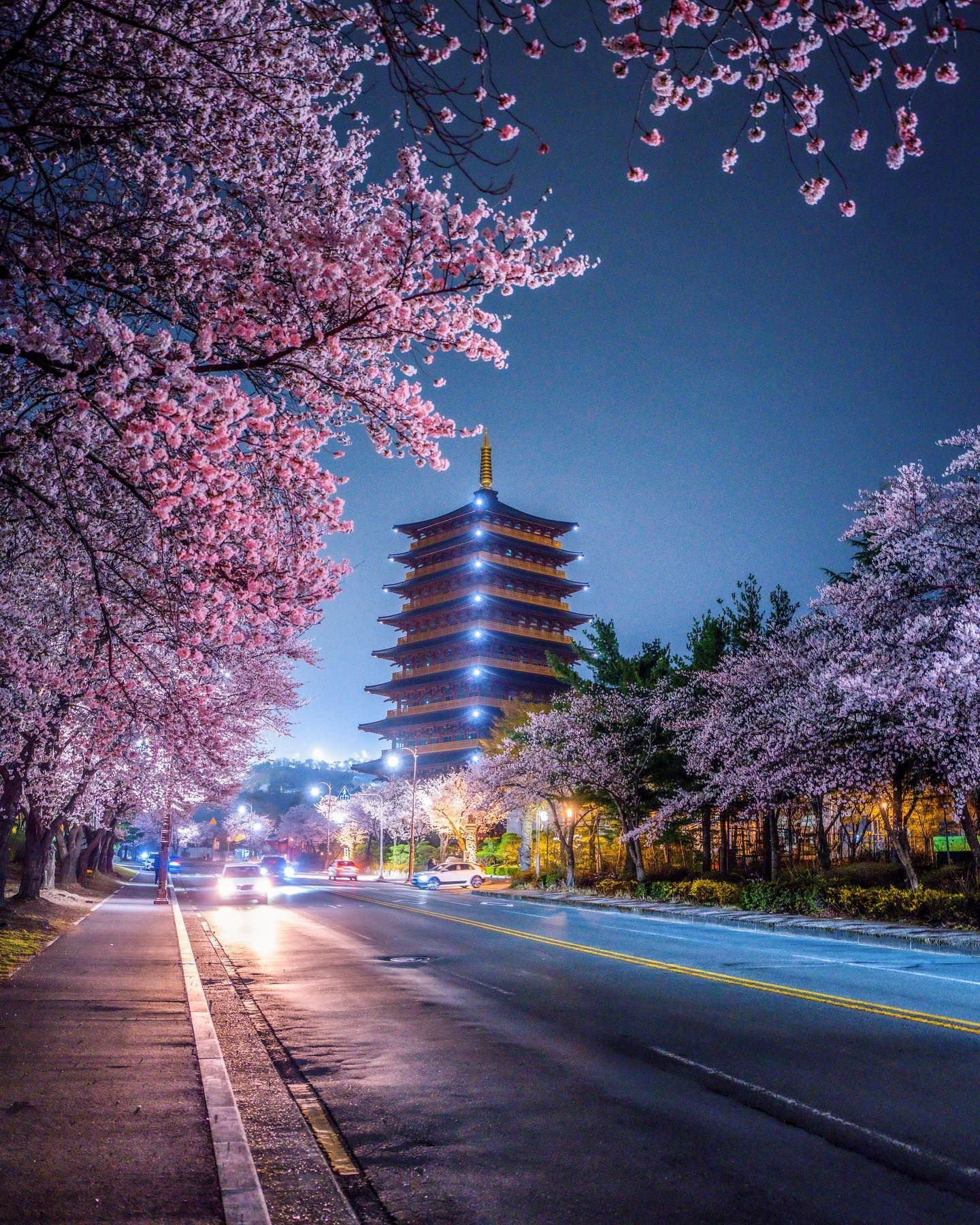
Gyeongju, Korea's ancient capital for nearly a millennium, offers something that modern cities cannot: cherry blossoms framed by 1,500-year-old heritage sites. The Bomun Lake area features a scenic 6-kilometer loop where cherry trees line the lakeside path, creating perfect reflections on the water's surface.
The night illumination here deserves special mention. Unlike the bright festival lighting at Jinhae, Gyeongju opts for subtle, warm lighting that enhances rather than overwhelms the natural beauty. Walking this path at dusk, with traditional pavilions silhouetted against pink blossoms, reminded me why Korea's approach to spring is so different from the West—it's deeply tied to history and cultural identity.
📍
Bomun Lake Cherry Blossom PathLocation: Bomun-ro, Gyeongju, North Gyeongsang Province (경북 경주시 보문로)
Walking Loop: 6 km around the lake
Best Time: Sunset hours (5:30-7:30 PM) for illumination
Getting There: KTX to Singyeongju Station, then bus 60 or taxi (15 min, USD $8-10 / KRW ₩10,800-13,500)
Nearby Attractions: Bulguksa Temple, Seokguram Grotto, Anapji Pond
View on Google Maps: Click to see the exact location
Busan: Coastal Cherry Blossom Experience
Daejeo Ecological Park (대저생태공원)

Here's where Korea's cherry blossom season reveals its most unique character. Daejeo Ecological Park combines pink cherry blossoms with bright yellow canola flowers, creating a color contrast that photographers dream about. The 3.4 million square meter park sits along the Nakdong River, offering wide-open spaces that feel worlds away from crowded urban festival sites.
This spot is particularly special for international visitors because it showcases Korean agricultural landscapes at their most beautiful. During my visit, I watched local families cycling through the paths, elderly couples taking leisurely strolls, and amateur photographers setting up tripods for the perfect shot. It's cherry blossom viewing with a distinctly local, unhurried pace.
📍
Daejeo Ecological ParkLocation: Daejeo 2-dong, Gangseo-gu, Busan (부산시 강서구 대저2동)
Best Time to Visit: Late March to early April
Getting There: Busan Metro Line 3 to Daejeo Station, Exit 1, then bus 126 or taxi (10 min, USD $5-7 / KRW ₩6,750-9,450)
Special Feature: Canola flowers bloom simultaneously with cherry blossoms
Admission: Free
View on Google Maps: Click to see the exact location
Hidden Gems: Beyond the Famous Spots
Seokchon Lake (석촌호수), Seoul
While tourists flock to Yeouido, locals often prefer Seokchon Lake in Songpa-gu. The lake is divided into east and west sections, both ringed with cherry trees. The bonus? Lotte World Tower provides a stunning modern backdrop for your photos, creating that perfect blend of nature and Seoul's futuristic skyline.
Getting There: Jamsil Station (Line 2/8), Exit 10, 5-minute walk
Best for: Families, couples, evening strolls
Peak Bloom: April 5-12, 2026 (estimated)
Namhansanseong Fortress (남한산성), Gwangju
This UNESCO World Heritage mountain fortress offers cherry blossoms with a side of Korean history and hiking. The 12-kilometer fortress wall is lined with cherry and azalea trees, and the elevation (480m) means you'll find blooms here even when lowland areas have finished.
Getting There: Namhansanseong Station (Line 8), then bus 9 (20 min)
Best for: Hikers, history buffs, photographers
Special Tip: Combine with a visit to traditional restaurants serving Namhansanseong makgeolli (rice wine)
Joshua's Real Story: My First Korean Cherry Blossom Season
I'll never forget my first cherry blossom season in Korea. Fresh from 15 years in Sydney, where spring meant allocating a specific Saturday to visit the tulips at Floriade, I assumed Korea would be similar—a nice event you visit once and move on.
I was completely wrong.
Korean cherry blossom season isn't an event; it's a cultural phenomenon that temporarily reorganizes the entire country's social calendar. My Korean colleagues started discussing blossom forecasts weeks in advance, planning weekend trips with the same intensity Australians plan beach holidays. When I suggested we could "just go whenever," they looked at me like I'd suggested showing up to a concert on the wrong day.
The revelation came during a spontaneous evening walk near Yeouido. I'd finished work late and decided to skip the crowded daytime festival. At 8 PM, under softly lit cherry trees with petals drifting through the warm spring air, I finally understood. This wasn't about seeing flowers—it was about marking the transition from harsh winter to gentle spring, a celebration deeply embedded in Korean cultural consciousness.
In Sydney, we appreciate spring blooms aesthetically. In Korea, cherry blossoms carry emotional weight, symbolizing renewal, the fleeting nature of beauty, and the cyclical nature of life. Once I grasped this, everything clicked: the crowds, the planning, the festival atmosphere, even the way people photograph the blossoms with almost reverential attention.
Practical Tips for International Travelers
Timing Your Visit
The golden rule: Track the Korea Meteorological Administration's bloom forecasts starting in mid-March. The peak bloom window is narrow—typically 7-10 days—so flexibility in your travel dates is crucial.
Accommodation Strategy
Book accommodations at least 8-12 weeks in advance for festival areas like Jinhae. Prices during peak season can increase by 200-300%, and availability disappears fast. Consider staying in nearby cities and day-tripping to major spots.
For example, instead of Jinhae, stay in Busan (40 minutes away by shuttle) where you'll find better hotel options and more dining variety.
Transportation Between Spots
Korea's excellent public transportation makes cherry blossom hopping feasible:
Seoul to Jinhae: Express bus from Seoul Express Bus Terminal (4.5 hours, USD $25-30 / KRW ₩33,750-40,500) or KTX to Changwon (2.5 hours, USD $45-60 / KRW ₩60,750-81,000)
Seoul to Gyeongju: KTX to Singyeongju Station (2 hours, USD $40-55 / KRW ₩54,000-74,250)
Seoul to Busan: KTX (2.5 hours, USD $50-65 / KRW ₩67,500-87,750)
Pro Tip: Purchase a T-money card (available at all convenience stores and subway stations) for seamless travel on buses and subways across Korea. Load it with USD $20-30 (KRW ₩27,000-40,500) to start.
Photography Tips
Best Light: Golden hour (6-7:30 AM and 5:30-7 PM) provides soft, warm light that makes blossoms glow
Avoid Harsh Midday Sun: Between 11 AM-3 PM, bright overhead sun washes out the delicate pink color
Bring a Polarizing Filter: If you're serious about photography, a circular polarizer deepens blue skies and reduces glare on petals
Respect the Trees: Don't shake branches for "petal shower" photos—it damages the trees and ruins the experience for others
What to Wear

Early April weather in Korea is unpredictable. Layer your clothing—mornings and evenings can be cool (10-15°C / 50-59°F), while midday can reach 20°C (68°F). A light jacket, comfortable walking shoes, and a small umbrella (for sudden spring showers) are essentials.
Hanbok Rental: Many visitors rent traditional Korean hanbok for cherry blossom photos. Rental shops near major spots charge USD $15-25 (KRW ₩20,250-33,750) for 2-4 hours. In Seoul, try neighborhoods near Gyeongbokgung Palace or Bukchon Hanok Village.
Food & Refreshments
Cherry blossom festivals mean street food paradise. Essential eats:
Hotteok (호떡): Sweet Korean pancakes filled with cinnamon sugar (USD $2-3 / KRW ₩2,700-4,050)
Tteokbokki (떡볶이): Spicy rice cakes (USD $3-5 / KRW ₩4,050-6,750)
Eomuk (어묵): Fish cake skewers in hot broth (USD $2-3 / KRW ₩2,700-4,050)
Bungeoppang (붕어빵): Fish-shaped pastry with sweet red bean filling (USD $1-2 / KRW ₩1,350-2,700)
Joshua's Recommended One-Day Cherry Blossom Itinerary (Seoul Base)
7:00 AM – Start at Seokchon Lake for peaceful early morning photos without crowds (1.5 hours)
🚇 Jamsil Station (Line 2/8)
9:30 AM – Subway to Yeouido (30 min travel time)
10:00 AM – Explore Yeouido Yunjung-ro before peak crowds arrive (2 hours)
🚇 Yeouido Station (Line 5) or National Assembly Station (Line 9)
12:30 PM – Lunch at nearby Yeouido traditional Korean restaurant or convenience store picnic under the blossoms
2:00 PM – Subway to Gyeongui Line Forest Park, Yeonnam-dong section (25 min travel)
🚇 Hongik University Station (Line 2)
2:30 PM – Walk the elevated park path, stop at trendy cafes (2-3 hours)
5:30 PM – Return to hotel to rest
7:00 PM – Evening return to Yeouido for illuminated night blossoms (optional) or explore Seongsu-dong for dinner
Transportation Note: Total subway travel approximately 1.5 hours. Each location offers 1.5-3 hours of exploration. This itinerary is realistic for a full day without feeling rushed.
Comparing Korea and Australia's Spring Culture
Having lived in both countries, the cultural approach to spring reveals fascinating differences:
Essential Apps & Resources
Bloom Forecast:
- Korea Meteorological Administration (기상청): www.kma.go.kr (Korean, use Google Translate)
- Kakao Map: Real-time cherry blossom updates and user reviews
Transportation:
- Naver Map or Kakao Map: More accurate than Google Maps for Korea
- Subway Korea App: English-friendly subway navigation
- Kakao T: Taxi-hailing app (requires Korean phone number or international credit card)
Translation:
- Papago (by Naver): Superior to Google Translate for Korean-English
- Google Translate: Camera function for reading Korean signs
Payments:
Most cherry blossom festival areas and street vendors accept cash and card. However, carry some cash (KRW ₩20,000-50,000 / USD $15-37) for smaller vendors who may be cash-only.
Weather Preparedness
Spring weather in Korea can surprise you. Based on historical patterns:
Average Temperatures (Late March-Mid April):
- Morning: 8-12°C (46-54°F)
- Afternoon: 15-20°C (59-68°F)
- Evening: 10-14°C (50-57°F)
Rain Probability: Approximately 20-30% during peak season. Spring showers are usually brief but can accelerate petal fall. If rain is forecasted, visit before the rain, not after—wet conditions cause petals to fall faster.
Wind: Gentle breezes create beautiful "petal snow" effects, but strong winds (15+ km/h) can strip trees quickly. Check wind forecasts if planning a specific day.
Respecting Korean Cherry Blossom Etiquette
- No Branch Shaking: Tempting for photos, but damages trees and is considered disrespectful
- Stay on Designated Paths: Trampling grass around tree bases harms root systems
- No Picnics Under Trees in Some Areas: Yeouido prohibits sitting directly under trees during festivals; use designated picnic areas
- Dispose of Trash Properly: Korea has limited public trash bins. Carry a small plastic bag to hold trash until you find a bin (usually near subway stations or convenience stores)
- Quiet Hours: In residential areas like Gyeongui Line Forest Park, keep noise levels down, especially early morning and evening
Beyond Cherry Blossoms: Spring Flowers in Korea
If you're visiting during late March to mid-April, you'll encounter other spring blooms:
Azaleas (진달래): Mountain slopes turn pink-purple, best in Jirisan and Seoraksan National Parks
Canola Flowers (유채꽃): Bright yellow fields, especially in Jeju Island and Busan Daejeo Park
Forsythia (개나리): Golden-yellow blooms lining city streets, usually peak 1 week before cherry blossoms
Magnolia (목련): Large white and pink blooms on elegant trees, often found in palace grounds
Related Guide
Exploring Korea beyond cherry blossoms? Discover more hidden gems in our Hot Spots category for trendy neighborhoods like Seongsu-dong and Ikseon-dong, or dive into our K-Food section for authentic Seoul restaurant guides.
Traveler's FAQ
Q1: Can I see cherry blossoms in Korea in May?
A: By May, lowland cherry blossoms have finished. However, higher elevation areas like Seoraksan National Park may still have late blooms in early May, though not guaranteed.
Q2: Is Jinhae worth the trip from Seoul?
A: Absolutely, if you have time. Jinhae offers the most immersive cherry blossom experience in Korea. However, if limited to Seoul, Yeouido and Seokchon Lake provide excellent alternatives without the travel time.
Q3: Do I need to book tours, or can I visit independently?
A: All major spots are accessible independently via public transportation. Tours are convenient but not necessary if you're comfortable using subway and bus systems.
Q4: Are cherry blossom spots wheelchair accessible?
A: Yeouido and Gyeongui Line Forest Park are mostly wheelchair accessible with paved, flat paths. Gyeongju Bomun Lake has accessible sections but some hilly areas. Jinhae's main Yeojwacheon Stream path is accessible, though crowded during festivals.
Q5: What if I miss the peak bloom?
A: Even post-peak, the experience is beautiful. Fallen petals carpeting the ground and floating on water create "petal snow" scenes that many find equally magical. Korea's spring also features forsythia, azaleas, and magnolias that bloom at slightly different times.
Author Bio
Joshua is a Seoul-based writer who spent 15 years living in Sydney, Australia. He writes about Korean travel, food, and culture through a cross-cultural lens, helping international visitors navigate Korea with practical insights shaped by life in both the Eastern and Western worlds.
Legal Disclosure & Transparency
Image Sources:
All images used in this post are sourced from licensed Creative Commons repositories including Unsplash, Pexels, and official tourism board press kits. If you are a rights holder and wish to have an image removed, please contact Joshua at mieluartkor@gmail.com for prompt removal.
Affiliate Disclosure:
This post contains affiliate links to hotel booking platforms. When you book through these links, we may earn a small commission at no additional cost to you. This helps support the creation of free, in-depth travel content. All recommendations are based on genuine research and personal experience.
Content Accuracy:
All information is accurate as of April 2026. Cherry blossom bloom dates are estimates based on meteorological forecasts and may vary due to weather conditions. Always verify festival dates, transportation schedules, and admission fees closer to your travel dates.


Comments
Post a Comment
"Welcome to KR Snap! Feel free to ask any questions about South Korea or share your thoughts."