If there's one aspect of Korean daily life that continues to amaze me even after years of living here, it's the convenience store culture. Coming from Sydney, where 7-Eleven meant grabbing a quick coffee or emergency snacks, I was completely unprepared for the culinary universe that exists within Korea's CU, GS25, and 7-Eleven stores.
Quick View: 3-Line Highlights
🏪 The Big Three: CU, GS25, and 7-Eleven dominate with 50,000+ locations offering restaurant-quality meals 24/7
💰 Budget-Friendly: Complete meals range from USD $2-6 (KRW ₩2,700-8,100), cheaper than most restaurants
🌙 Survival Essential: Open 24/7 with seating areas, microwaves, hot water, and even free utensils—your late-night lifeline in Korea
Why Korean Convenience Stores Are Different
In Australia, convenience stores serve a simple purpose: quick purchases when everything else is closed. Korean convenience stores, however, function as mini-restaurants, social hubs, and cultural institutions. They're where students study late at night, office workers grab lunch, and travelers discover some of Korea's best budget eats.
The secret lies in Korea's competitive retail landscape. With over 50,000 convenience stores nationwide (that's one store for every 1,000 people), chains compete fiercely by developing exclusive food products that rival actual restaurants in quality. Major food manufacturers create items specifically for convenience store brands, resulting in constantly rotating menus with seasonal specialties and viral trending items.
The Big Three: CU vs. GS25 vs. 7-Eleven
CU (씨유)
Market Leader: Korea's largest convenience store chain with 17,000+ locations
Strengths: Exclusive collaborations with Korean celebrities and brands, innovative limited-edition products
Signature Items: Heyroo (헤이루) premium meal series, CU-exclusive Korean traditional snacks
Price Range: Generally USD $1.50-5 (KRW ₩2,025-6,750) for most ready-to-eat items
Joshua's Take: CU feels the most "Korean" of the three chains. They frequently partner with K-pop idols to create exclusive product lines, making them a favorite among younger Koreans and international fans hunting for limited-edition merchandise.
GS25 (지에스25)
Market Position: Second-largest chain with 16,000+ locations
Strengths: Best quality control and premium positioning, excellent fresh food selection
Signature Items: You Us (유어스) gourmet line, artisan sandwiches, imported snacks
Price Range: Slightly higher at USD $2-6 (KRW ₩2,700-8,100), but perceived as better quality
Joshua's Take: If CU is trendy, GS25 is sophisticated. Their stores tend to be cleaner and more spacious, with better lighting—almost approaching the aesthetic of a small supermarket. Coming from Woolworths Metro stores in Sydney, GS25 feels the most familiar in terms of shopping experience.
7-Eleven (세븐일레븐)

Market Position: Third place with 11,000+ locations
Strengths: International product selection, familiar brand for travelers
Signature Items: 7-Select private label, Japanese-style onigiri, imported candy
Price Range: USD $1.50-5 (KRW ₩2,025-6,750), competitive with CU
Joshua's Take: Korean 7-Eleven bears little resemblance to its Australian or American counterparts. The food quality is exponentially better, and they've localized completely while maintaining some international familiarity.
Must-Try Foods: The Essential Convenience Store Bucket List
1. Triangle Kimbap (삼각김밥) - The Icon

The convenience store staple that launched a thousand late-night study sessions. Triangle kimbap combines seasoned rice with various fillings, wrapped in crispy seaweed (gim), all cleverly packaged so the seaweed stays separate until you're ready to eat.
How to Open It: This confuses every first-timer. Pull the red tab labeled "1" down the center, then pull tabs "2" and "3" outward. The packaging splits in three pieces, leaving you with perfectly wrapped kimbap with crispy seaweed.
Top Flavors to Try:
- Tuna Mayo (참치마요): The classic, can't-go-wrong option - USD $1.20-1.50 (KRW ₩1,620-2,025)
- Spicy Bulgogi (매운불고기): Sweet-spicy Korean beef - USD $1.50-1.80 (KRW ₩2,025-2,430)
- Kimchi Fried Rice (김치볶음밥): Tangy and savory - USD $1.30-1.60 (KRW ₩1,755-2,160)
- Spam (스팸): A Korean favorite since the 1950s - USD $1.40-1.70 (KRW ₩1,890-2,295)
Joshua's Insight: This is the Korean equivalent of Australia's Vegemite toast—culturally significant comfort food that locals eat without thinking but foreigners find fascinating. I've watched Korean friends methodically work through three different flavors as a complete meal.
2. Dosirak (도시락) - The Lunch Box Revolution

These aren't your typical sad desk lunch boxes. Korean convenience store dosirak are complete, balanced meals featuring rice, protein (usually bulgogi, chicken, or fish), vegetables, and banchan (side dishes) that you'd find in a proper restaurant.
How to Heat: Remove the outer plastic wrap (leave the inner film). Microwave on high for 2-3 minutes (microwaves are free in every convenience store). Let it sit for 30 seconds, carefully peel back the film (steam will be hot!), and mix everything together.
Best Options:
- Bulgogi Dosirak (불고기도시락): Sweet marinated beef with rice and vegetables - USD $4-5 (KRW ₩5,400-6,750)
- Chicken Mayo Dosirak (치킨마요도시락): Fried chicken chunks with mayo sauce - USD $3.50-4.50 (KRW ₩4,725-6,075)
- Kimchi Stew Dosirak (김치찌개도시락): Rice with kimchi stew on the side - USD $4.50-5.50 (KRW ₩6,075-7,425)
Pro Tip: The rice at the bottom often sticks to the container. Add a splash of hot water from the convenience store's free hot water dispenser before microwaving to make it fluffier.
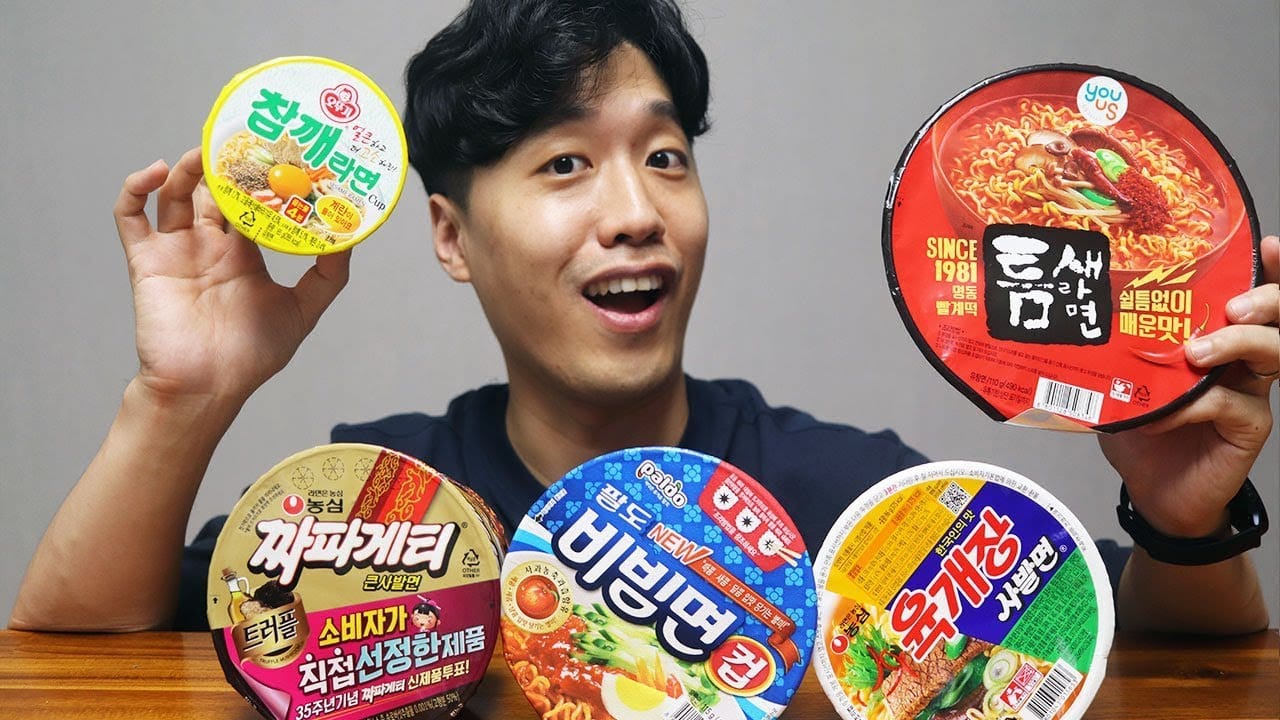
Korean ramyeon culture is serious business. Convenience stores stock 50+ varieties, from nuclear-spicy challenges to creamy comfort bowls. The instant noodle section receives more product development attention than entire restaurants in other countries.
Convenience Store Ramyeon Ritual:
- Choose your ramyeon (cup or packet)
- If cup: Fill to the line with hot water from the dispenser, close lid, wait 3 minutes
- If packet: Ask staff for a bowl (공기 - gonggi), add noodles and hot water, microwave 3 minutes
Essential Varieties:
- Shin Ramyun (신라면): The OG spicy ramyeon, a national icon - USD $1.20 (KRW ₩1,620)
- Buldak Bokkeum Myeon (불닭볶음면): "Fire chicken" ultra-spicy stir-fry noodles - USD $1.50 (KRW ₩2,025)
- Jin Ramen Mild (진라면 순한맛): For those who can't handle spice - USD $1.10 (KRW ₩1,485)
- Jjapaguri (짜파구리): Mix of Chapagetti + Neoguri, made famous by the film Parasite - USD $2.50 (KRW ₩3,375) for both packets
Ramyeon Hacks from Locals:
- Add a slice of cheese on top during the last 30 seconds of cooking (melted cheese tames spice and adds creaminess)
- Crack a raw egg into the boiling noodles for protein and richness
- Grab a triangle kimbap to eat alongside—the perfect combination
4. Korean Fried Chicken & Snacks (치킨·간식)
Convenience stores sell ready-to-eat fried chicken, Korean fried rice cakes (tteokbokki), fish cakes (eomuk), and more—all heated fresh throughout the day.
Top Picks:
- Fried Chicken (치킨): Usually wings or drumsticks in sweet-spicy sauce - USD $3-4 (KRW ₩4,050-5,400) for 4-5 pieces
- Tteokbokki (떡볶이): Spicy rice cakes in gochujang sauce - USD $2.50-3.50 (KRW ₩3,375-4,725)
- Odeng/Eomuk (어묵): Fish cake skewers - USD $1-1.50 (KRW ₩1,350-2,025) per skewer
- Korean Corn Dogs (핫도그): Mozzarella or sweet potato coated in crispy batter - USD $2-2.50 (KRW ₩2,700-3,375)
5. Desserts & Drinks - The Sweet Finale

Korean convenience store desserts deserve their own UNESCO designation. Ice cream bars with names like "Melona," "Together," and "World Cone" have cult followings.
Ice Cream Legends:
- Melona (메로나): Honeydew melon popsicle, Korea's #1 ice cream bar - USD $1-1.20 (KRW ₩1,350-1,620)
- Bba Bba Bar (빠빠바): Red bean ice cream bar with crispy coating - USD $1.20-1.50 (KRW ₩1,620-2,025)
- Together (투게더): Vanilla-chocolate combo bar, perfect for sharing - USD $1.50-1.80 (KRW ₩2,025-2,430)
Drinks You Can't Get Elsewhere:
- Banana Milk (바나나맛 우유): The iconic yellow bottle from Binggrae - USD $1.20 (KRW ₩1,620)
- Milkis (밀키스): Carbonated milk-yogurt drink - USD $1.50 (KRW ₩2,025)
- Chilsung Cider (칠성사이다): Korea's answer to Sprite, but better - USD $1.30 (KRW ₩1,755)
- Soju (소주): If you're of legal drinking age, the most popular alcoholic drink in Korea - USD $1.50-2 (KRW ₩2,025-2,700)
Joshua's Real Story: My Convenience Store Awakening
My first week in Korea, I made the classic Western expat mistake: I bought groceries thinking I'd cook at home to save money, just like I did in Sydney. Then I discovered convenience store dosirak cost less than the ingredients for a single meal.
One rainy Tuesday evening, exhausted after a long day, I ducked into a GS25 near my apartment. A Korean university student noticed my confused stare at the dosirak section and, in broken English, guided me through the entire process: which dosirak to buy, how long to microwave it, where to find free pickled radish (danmuji) to eat alongside.
That USD $4.50 (KRW ₩6,075) bulgogi dosirak—with perfectly seasoned rice, tender beef, stir-fried vegetables, and a tiny portion of kimchi—tasted better than many USD $15 restaurant meals I'd had. The student sat down at the convenience store's standing table with her own ramyeon, and we ate in comfortable silence, surrounded by other late-night diners doing the exact same thing.
That moment crystallized something I'd been sensing but hadn't articulated: Korean convenience stores aren't just retail spaces. They're social equalizers where CEOs and students eat the same USD $3 meals, where 3 AM feels as welcoming as 3 PM, and where being alone never feels lonely because you're surrounded by others doing the same thing.
In Sydney, eating alone at a 7-Eleven would feel sad—a sign that something went wrong with your day. In Korea, eating at a convenience store is just... normal. It's efficient, economical, and surprisingly pleasant.
Survival Guide: Navigating Korean Convenience Stores Like a Local
The Kiosk Challenge

Many Korean convenience stores now use self-checkout kiosks to reduce labor costs. While efficient, they're often Korean-only with no English option.
Kiosk Survival Strategy:
- Scan Your Items: Hold the barcode under the red scanner light until you hear a beep
- Look for These Buttons:
- 결제 (Gyeolje) = "Pay" / "Checkout"
- 카드 (Kadeu) = "Card"
- 현금 (Hyeongeum) = "Cash"
- 취소 (Chwiso) = "Cancel"
- Payment: Insert your card chip-side up, follow prompts, collect receipt
- If Stuck: Say "도와주세요 (Dowa-juseyo)" = "Please help me." Staff will assist immediately.
Pro Hack: Download Papago translation app. Use the camera function to point at the kiosk screen for real-time Korean-to-English translation.
The Receipt Secret: Bathroom Door Codes
Here's something no guidebook tells you: In older neighborhoods, public restroom doors are locked with keypad codes printed on receipts.
After purchasing anything at a convenience store, check the bottom of your receipt. You'll often see a 4-digit code—that's the restroom door passcode. This system prevents non-customers from using facilities while giving paying customers access.
Restroom Phrase:
"화장실 어디에요? (Hwajangsil eodi-eyo?)" = "Where is the bathroom?"
Free Amenities You Should Absolutely Use
Korean convenience stores offer services that would cost money elsewhere:
- Hot Water Dispensers (온수기): Free hot water for ramyeon, tea, or instant coffee
- Microwaves (전자레인지): Heat your food for free
- Utensils (수저): Free chopsticks, spoons, forks in dispensers near the checkout
- Wet Wipes (물티슈): Take one or two for your meal
- Pickled Radish (단무지): Small free side dish near the microwaves (pairs perfectly with ramyeon)
- Trash & Recycling: Separate bins for general waste, plastic, and food waste
Cultural Note: While these amenities are free, take only what you need. Koreans value moderation, and taking excessive amounts is considered rude.
Payment Methods
Korea is essentially cashless, and convenience stores reflect this:
- Credit/Debit Cards: Accepted everywhere, including international Visa/Mastercard
- T-money Card: Rechargeable transit card that also works for convenience store purchases
- Samsung Pay / Apple Pay: Widely accepted at most chains
- Cash: Still accepted, but increasingly rare to see
Money-Saving Tip: Pay with T-money or loyalty apps (CU's Pocket CU, GS25's GS Pay) to earn points redeemable for future purchases.
Store Layouts & Finding What You Want
Korean convenience stores follow a predictable layout:
Key Phrases:
- "이거 어디 있어요? (Igeo eodi isseoyo?)" = "Where is this?"
- "전자레인지 쓸 수 있어요? (Jeonjalenji sseul su isseoyo?)" = "Can I use the microwave?"
Comparing Korean and Australian Convenience Store Culture
Having lived extensively in both countries, the differences are striking:
Seasonal & Limited-Edition Culture
Korean convenience stores thrive on "limited edition" culture. New products launch weekly, and Koreans actively hunt for seasonal specialties.
Spring (March-May):
- Cherry blossom-flavored snacks and drinks
- Strawberry desserts (Korea goes strawberry-crazy in spring)
- Light, refreshing beverages
Summer (June-August):
- Shaved ice cups (bingsu 빙수)
- Watermelon-flavored everything
- Cold noodle dosirak (naengmyeon 냉면)
Fall (September-November):
- Sweet potato products (roasted sweet potato, sweet potato latte)
- Chestnut snacks
- Pumpkin-flavored items
Winter (December-February):
- Warm dosirak with stew
- Hot oden/eomuk (fish cake soup)
- Warming drinks (ginger tea, citron tea)
Viral Products: Follow Korean social media (Instagram hashtag #편의점 or #편스타그램) to discover what's trending. Products can sell out within hours of going viral.
Money-Saving Strategies
Korean convenience stores run constant "1+1" (buy one get one free) and "2+1" (buy two get one free) promotions. Look for bright red or yellow tags.
Best Strategy: Check the promotion shelf near the entrance. Items rotate weekly, so what's on sale Tuesday might not be Thursday.
Meal Combos
Pre-packaged combos (도시락 세트) offer better value than buying items separately:
- Ramyeon + Triangle Kimbap: USD $2.50 (KRW ₩3,375)
- Dosirak + Drink: USD $5 (KRW ₩6,750)
- Snack Pack (3 items): USD $4 (KRW ₩5,400)
Loyalty Apps
Download store-specific apps for exclusive coupons:
- CU Pocket CU App: Earn points, mobile coupons
- GS25 GS Pay App: Digital wallet with rewards
- 7-Eleven Korea App: Event notifications, discounts
Best Value Meals Under USD $5 (KRW ₩6,750)
- Triangle Kimbap (2 pcs) + Banana Milk = USD $3.50 (KRW ₩4,725)
- Ramyeon Cup + Fried Chicken (3 pcs) = USD $4.50 (KRW ₩6,075)
- Basic Dosirak + Canned Coffee = USD $4.80 (KRW ₩6,480)
Special Dietary Considerations
Vegetarian / Vegan Options
Korean convenience stores are challenging for strict vegetarians due to widespread use of meat-based broths and fish sauce. However, options exist:
Vegetarian-Friendly:
- Plain Onigiri/Triangle Kimbap (김 only): Some varieties use only seasoned rice and seaweed
- Chips & Snacks: Honey Butter Chips, Sweet Potato Snacks (check ingredients)
- Fruit Cups: Pre-cut fresh fruit
- Bread & Pastries: Red bean buns (단팥빵), cream-filled pastries
Caution Items:
- Most ramyeon contains meat/fish broth
- Kimbap often contains fish cake or spam
- Read labels carefully or ask staff
Key Phrase: "고기 없어요? (Gogi eopseoyo?)" = "Is there no meat?"
Halal Considerations
Korea has limited Halal certification, and convenience stores rarely carry certified Halal items. Muslims should:
- Avoid obvious pork products (햄/ham, 돈까스/pork cutlet)
- Choose vegetarian options when possible
- Look for seafood-based items (tuna kimbap, fish cake)
- Download Halal Korea App for certified products list
Joshua's Top 10 Convenience Store Picks
After years of systematic convenience store sampling (yes, it's been rigorous research), here's my definitive ranking:
- Tuna Mayo Triangle Kimbap - The reliable friend who never disappoints
- GS25 Bulgogi Dosirak - Best value-to-quality ratio
- Buldak Bokkeum Myeon - When you want to test your spice tolerance
- Korean Fried Chicken Wings - Crispy, saucy perfection at 2 AM
- Melona Ice Cream Bar - Honeydew melon nostalgia in frozen form
- Banana Milk - Korea's liquid sunshine
- Jjapaguri - Parasite made it famous; taste makes it legendary
- CU Heyroo Premium Dosirak - Splurge-worthy when you're tired of instant food
- Cheese Tteokbokki - Spicy rice cakes with melted mozzarella
- Ppoppo (뽀뽀) Ice Cream - Chocolate-covered ice cream on a stick
Related Guide
Craving more Korean food adventures? Explore our K-Food category for in-depth Seoul restaurant guides, or check out Travel Tips for essential apps and transportation hacks to navigate Korea like a local.
Traveler's FAQ
Q1: Are Korean convenience stores safe to eat from?
A: Absolutely. Food safety standards in Korea are extremely high, and convenience stores are inspected regularly. Expiration dates are strictly enforced—items are removed from shelves hours before they expire.
Q2: Can I eat inside the convenience store?
A: Yes! Most convenience stores have standing tables or small seating areas specifically for customers to eat. It's completely normal and expected. Some larger stores even have dedicated cafe-style seating.
Q3: Do I need to speak Korean to shop at convenience stores?
A: Not necessary, but helpful. Most checkout processes are straightforward (scan items, pay by card). Use translation apps like Papago for reading labels or asking staff questions.
Q4: What are the store hours?
A: The vast majority (90%+) of Korean convenience stores operate 24/7. Some smaller locations in residential areas may close briefly (3-6 AM) for restocking, but this is rare.
Q5: How much should I budget for convenience store meals?
A: Budget USD $10-15 per day (KRW ₩13,500-20,250) for three convenience store meals. This gets you breakfast (triangle kimbap + drink), lunch (dosirak), and dinner (ramyeon + snacks), which is cheaper than one sit-down restaurant meal.
Author Bio
Joshua is a Seoul-based writer who spent 15 years living in Sydney, Australia. He writes about Korean travel, food, and culture through a cross-cultural lens, helping international visitors navigate Korea with practical insights shaped by life in both the Eastern and Western worlds.
Legal Disclosure & Transparency
Image Sources:
All images used in this post are sourced from licensed Creative Commons repositories including Unsplash, Pexels, Wikimedia Commons, and official press kits. If you are a rights holder and wish to have an image removed, please contact Joshua at mieluartkor@gmail.com for prompt removal.
Affiliate Disclosure:
This post may contain affiliate links. When you make a purchase through these links, we may earn a small commission at no additional cost to you. This helps support the creation of free, in-depth travel content. All recommendations are based on genuine research and personal experience.
Content Accuracy:
All information including prices and product availability is accurate as of April 2026. Convenience store product lines change frequently due to seasonal rotations and limited-edition releases. Always verify current offerings at the store.
Brand Neutrality:
This guide is not sponsored by CU, GS25, 7-Eleven, or any convenience store chain. All opinions are based on personal experience and independent research.


Comments
Post a Comment
"Welcome to KR Snap! Feel free to ask any questions about South Korea or share your thoughts."